Wednesday, July 4, 2012

At the table with the Gods

Mount Olympus is one of the most known landmarks of Greece and not for its height, which is anything but negligible, over 2900m, but for being the home of the ancient Gods. Zeus himself is known to have thrown his fierce thunderbolts from the highest peak of Olympus, Mytikas.
Getting there is not for everyone or so the legend says. Only the pure hearted are granted the honor of being in the presence of the Gods.

Hoping that I will prove worthy of meeting with them, I start my trip at the foot of the great mountain where lies a small and quiet village called Litochoro which is going to be my home for the night.

To my surprise, the village has a quite vivid night life, a lot of taverns worth remembering and a mean ice-cream place. The only downside is that lodging tends to be a bit overpriced in summer since it’s the only village close enough to the mountain to allow you to wake up in the morning and start walking.

Most people who aim on climbing the highest peak, Mytikas, start walking from Prionia (1100m), the last refuge up to which you can go by car. From there, it’s a two to three hour hike to the next refuge, Olympus A (2100m) from where you can start planning your last assault on the top.

At Refuge A you find people from all over the world speaking all kinds of languages you have never heard before so it is also a cultural experience. What is even more important is that everybody’s friends there. The mountain draws everybody closer together.

Rising early is critical on the day of the peak climb. The path is not difficult up to Skala (2866m) but is very abrupt and it required a lot of effort. Also, there is no water source on the way up so it is vital to take enough water for going and coming back, which is going to be a considerable amount of hours.

The mountains have usually their own weather so if you wake up in the morning and find yourself in a mist so dens you can hardly see your hands in front of you, as I did. Don’t despair! Mountain weather can change any minute radically.

From Skala to Mytikas the difficulty of the path increases. The way is not steep enough to climb but not flat enough to walk on so I need to “scramble”. A rope would be very useful in this section of the climb but I wasn’t that inspired. This part is a bit harder but getting to the top and meeting Zeus himself is worth all the efforts.

Since I still had a few days left to wonder around on the mountain I decided to visit the Muses Plateau. They say that there, on that plateau, if you are very attentive you can see the muses dancing and singing in the winds that caress those heights.

I start my trip from Refuge A and continue the same way I went the previous day up to a point where the map shows me the entrance to Zonaria. In Greek, “zoni” means belt and this path looks exactly like one. It is not a risky path but it does require all your attention since it is very narrow and gravelly.

Kakalos refuge guards the entrance to the plateau. It’s a small colorful place that gathers experienced climbers from all over the world, the raw kind of mountain people that don’t mind sleeping on the edge of a cliff with no tent or enjoy drinking their coffees outside at 12 degrees while sunbathing in their shorts. Even though it was a sunny August the temperature up there was more of a chilly spring.

The plateau is green, quiet and welcoming. I can easily imagine why people thought of it to be the home of the muses. After the rush of the climb, suddenly I found myself in the serene and eternally green fields of the muses.

For a church, this is hardly the place to be and yet, at almost 2650m above the sea level, I found “Profitis Ilias” (Ilias Prophet). It’s not the typical kind of church though since it is made of piles of rocks found on the plateau.
I know what you might think. That it was made having in mind a more touristic purpose rather than a religious one. To my surprise “Profitis Ilias” is a perfectly functional church. I even found out that some days before a couple got married there.

A small tip before the end, if you happen to find yourself on Olympus in mid August there is no better place on earth to see the Perseides, the meteorite shower that starts on the 9th and lasts up to the 14th of August.

And this particular year, all through the month of August, you can see the planet Mars which will be very close to earth and on the 27th of August will appear as big as the Moon.

Thursday, June 28, 2012

The Wrath of Titans or How the Greeks Became Christians

Yesterday I’ve seen “The Wrath of Titans”, a movie about which I’ve only heard bad critics but I decided to see it anyway. What can I say, I’m a sucker for lost causes. It’s supposed to be based on Greek mythology but after the repeated rape of Greek mythology in “Clash of Titans” and “Immortals” there was not much hope left in me.
The movie starts and we are reminded of how Perseus killed the Kraken. It doesn’t even matter that the Kraken had never crossed paths with Greek mythology. It’s a fancy name that deserves to be used in a movie, or two, or ten.
Who's he suppose to be? St. George?
The story is that, frustrated by his father’s favoritism to Perseus, Ares joins forces with Hades in order to release Chronos . What’s wrong with this idea? Well, let’s see. Chronos was the one that, feeling threatened by the fact that his kids will grow up and take his place, decided to eat them.  So, Zeus and Hades had shared their dad’s stomach once before. How probable it is that Hades would wish for another family reunion like this?

And talking about the family reunion, the only Olympian gods that we have in this movie are: Zeus, Hades, Poseidon, Hephaistos and  Ares. What happened to the other gods? There are Athena, Aphrodite, Hermes or  Apollo? By how bad this movie is going I think they died of boredom.
There is one thing that the people who made the movie really didn’t get about the gods. THEY WERE IMMORTAL! In this movie you have a god dieing every 15 minutes! Out of the five gods that are representing Olympus in this movie, the only one who survives is Hades.
The Death of the Gods and the Rise of the New Religion
The only conclusion I can reach is that according to this movie, the Greeks ran out of gods and started asking around for a new religion and that’s how they’ve stumbled upon Christianity (“Nice religion, we’ll take two” – since Greeks are twice as religious as every other Christian on the face of the earth having Mount Athos and all).

Tuesday, June 26, 2012

Greek Traffic Laws Unleashed

Some days ago, there was a news that appeared on the Greek sites about a guy who went to jail 30 days for driving without a license. Until now, nothing out of ordinary. What is truly interesting though is what the guy was driving and the answer is: a bicycle. 

So, yes good people, in Greece you can get a fine (or go to jail)  for driving your bicycle without a permit. You might make the mistake of thinking that since Greece is part of the European Union and in all the other countries of the EU you don't need a permit, you won't need a permit in Greece either. But then again, you forget what I always tell you: Greece is Special!

Initially I thought this is a joke but apparently it's not. There is a law in Greece which says that bicycle drivers need to have a permit and it actually overrules the European law.

My advice to you would be to stay away from Igoumenitsa if you have a bicycle and you want to ride it. I hope that the sudden interest for this law will not spread all over the country and they will manage to contain it or even eradicate it from Igoumenitsa also.

Source: http://www.katoci.com/2012/06/30.html

Saturday, June 23, 2012

Beginning of Summer in Greece

I came back to Greece the other day and, I don't know why, I was hoping for a a more breathable temperature. In Romania, when I left there were 37 degrees, today in Thessaloniki the car thermometer showed 43 degrees. So, no chance! 
Bottom line, SUMMER IS BACK and it's here to stay with the good and the bad. I must tell you that the temperature of the sea is just perfect so whomever didn't go for a swim yet, SHOULD!

There are also not so nice things happening because of the heat. Today we were passing by a stores area that is near some fields. The fields caught fire because of the sun and so did some back yards. 


Sunday, June 17, 2012

First Look on the Greek Elections from Today


At a first glimpse it seams that Nea Democratia is going to win these elections but then again, these are only 25% of the votes.

The alarming news is that after all the stands the Golden Dawn have pulled in the last months they still have chances of getting into the Parliament.


See Source


Tuesday, June 12, 2012

Castra Piano Bar

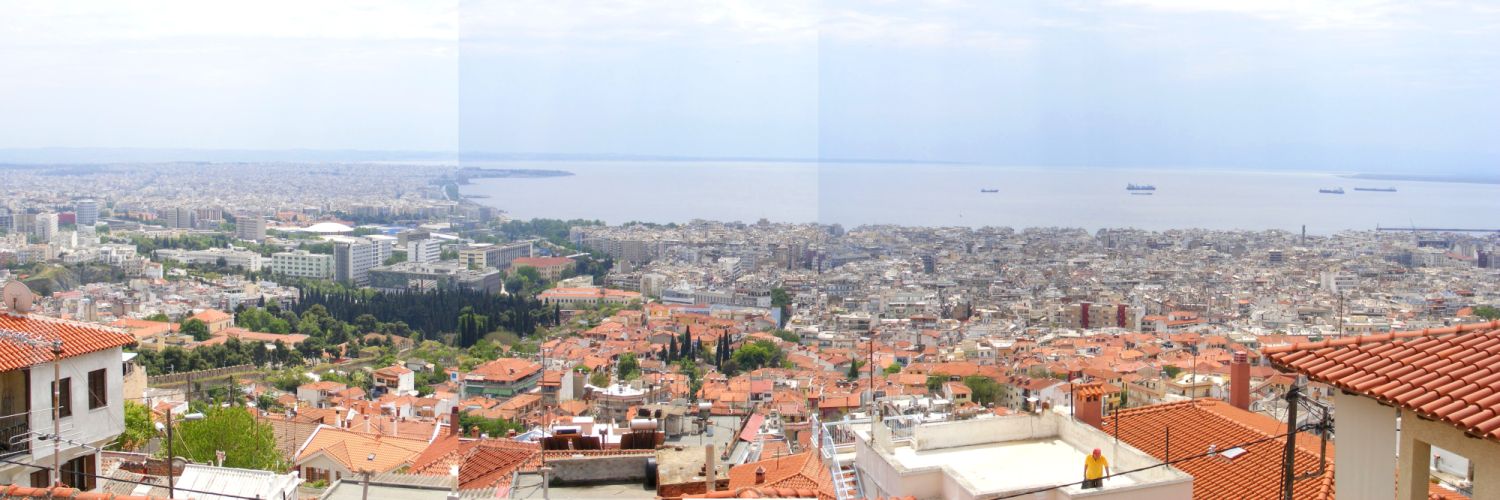
I realized that I've been having this blog for a few months now and I have never talked about places I like in Thessaloniki. So, the first one I'll tell you about is Castra Piano Bar. This place has one of the most amazing views of the city. I really enjoy my coffee with a view so that makes it one of my favorite places.
Here is a small preview. The view by night is even more spectacular.
View of Thessaloniki from Castra Piano Bar

Friday, June 8, 2012

Greek Baptism

I mentioned in a previous article that the baptizing in Greece is an adventure.
Let’s start with the beginning…You know that simple thing you do: talk to a priest one day, get the baby without its consent the next, immerse it in water and Puf! the baby is baptized? Well…forget about it in Greece.
 

First of all, in Greece children are baptized as old as 7-8 even 9 months and up until that age most parents call their baby, “baby” because, since it is not baptized, tradition states that they are not allowed to use any names.

From the moment the baby is born up until the baptizing, “The battle for the name” takes place. I have talked about it in a previous post. The closer the baptizing gets the more biting the battle becomes. Until the end when, traditionally, “There can be only one!”. Now day’s people start giving their kids two names also but traditionally it’s only one. It would be better if the name was a Christian one (apart from being the name from one of the grandparents) because otherwise the priest might not be very happy your choice.

One important element in the baptizing ceremony is the god parent. Tradition says that the best man at a wedding will be the godfather of the couple’s first child. I have no idea how it goes for the second or the third kid. I guess you just get to choose the god parents.
Before the ceremony, the god parent needs to prove his belonging to the Christian faith, at least on paper. He needs to obtain an official document stating the fact that he was baptized as Christian.

As a social event, the baptizing here in Greece is the equivalent of a wedding. Even the baby’s dress (costume if it’s a boy) costs at the level of a miniature wedding outfit. I’ve seen baptizing dresses for girls for 250-300E and they were not the most expensive.

From the religious point of view it’s a very good business. The god parent needs to pay the church  while the parent needs to pay the priest. That also might rise to 130-150E. And to think we are talking about a country in crisis.
Overall it seems that faith has become very expensive “habit” these days.

Monday, June 4, 2012

Some Odd Greek Names

Female names
AKANTHA Meaning “thorn”
ALALAShe is the sister of Ares, the personification of the war cry. The name literally means “war-like”
AMALTHEIA Means "to soothe".
CHARIKLO
(read Hariclo)
Meaning "graceful spinner”. This is the name of the nymph wife of Kheiron the centaur.
CHRYSANTHE
(read Xrisanthi)
It means “golden flower”
DIANTHE
(read Dianthi)
“god-flower”
EFTHALIA “Blooming”
ERATO Meaning "lovely." In mythology, this is the name of the muse of poetry
EUADNE
(read Evadne)
Eu "good, well" and adnos "holy," hence "good and holy."
EUPRAXIA “good conduct"
GORGOPHONEGorgo "grim" and phonos "murderer, slayer," hence "grim slayer.
KALLIGENEIAKallos "beauty" and genes "born," hence "beauty-born.
KLYTAIMNESTRA
(read Klytemnestra)
Klytos "famous, praiseworthy," and mnestria "wooing," hence "famous for her suitors.
LEUKOTHEALeukos "white" and thea "goddess," hence "white goddess”.
MEGAIRA
(read Megera)
Meaning "grudge." In mythology, this is the name of one of the Furies.
PSYKHE
(read Psihi)
Meaning “soul”
PTOLEMAMeaning "aggressive” or “warlike."
POLYMNIAMeaning “many hymns”.
THEOPHANIA Meaning "manifestation of God.”
TISIPHONE Tisis "retribution" and phone "murder," hence "murder-retribution
Male names
AGATHANGELOS Agathos "good" and angelos "angel," meaning "good angel"
AMARANTHOS Meaning "unfading"
APHRODISIOS Meaning "risen from the foam"
VOANERGES Meaning "sons of thunder"
DIONYSODOROS Meaning "gift of Dionysos
KADMOS Meaning "the East."
KALOGEROS Kalos "beautiful" and geron "elder," hence "beautiful elder"
LYKAON Meaning "wolf"
LYSISTRATOS Lysis "freeing, release" and stratos "army," hence "liberation army"
METROPHANES Meter "mother" and phanes "appearing, looking" hence "mother-looking"
NEOPTOLEMOS Neos "new" and polemos "war," hence "new war”
OLYMPIODOROS Olympos and the word doron "gift," hence "gift of Olympos”
OPHIOUCHOS
(read Ophiuxos)
Meaning "serpent bearer”
PANTHERAS Pan "all" and therao "to hunt," hence "all-hunter – So that’s where the word “panther comes from…ahaaaaa…
PHOBOS Meaning "fear". In mythology, this is the name of a son of Ares.
PHRIXOS Word phrix, meaning " the shivering of skin from fear”.
POLYDEUKES
(read Polydevkes)
Polys "much" and deukes "sweet," hence "very sweet
TELESPHOROS Meaning "bearing fruit”
THERISTÍS Meaning "mowing month”. It may also mean "the reaper"
XENOCRATES Xenos "foreign, strange," and kratos "power," hence "foreign power”

Wednesday, May 30, 2012

Names in Greece

For people who are not familiarized with the Greek culture, some of the Greek names may sound a bit pompous and hard to live up to like Athena (Goddess of Wisdom) , Ares ( God of War) or Aphrodite (Goddess of Beauty). In Greece though they are common names and people don't seem to be pressed by the weight of their names as it happens in other places. Which is a very good thing.

The not so good thing is that, according to tradition, the new born is named after one of the grandmothers if it's a girl and grandfathers if it's a boy. Greek parents rarely consider the option of naming their kids with a different name. This is a moment of strong friction and serious discussions in the family with logical arguments like "My mother's name is better than your mother's name".

By now the grandparents already started putting pressure on the couple in order to make sure they will chose the name from their own side of the family. If that doesn't happen these arguments may end up bad and families may cease to talk to each other for years just because "You chose the other grandmother's name for your kid".

The choosing of the grandparents name is considered to be a sign of respect and gratitude, a tribute to the person who raised and took care of you. But if that is the case, why do you only chose to show your respect to one of the grandparents and not to both of them? 

Another explanation I heard recently is that it all has to do with the money. Couples chosen the name from the more wealthy family, the one who can provide better for the kid.

So, overall, this is the reason for which, from all the beautiful names that Greek history and mythology provide, 90% of Greek males are called: Giorgos, Yannis, Konstantinos (Kostas), Dimitris or Nikolaos(Nikos) while top five Greek female names covering probably almost the same percentage of the population are: Maria, Eleni, Katerina, Georgia and Anna.

Since Thessaloniki is the birthplace of Agios Dimitris you will find here a particularly high density of Dimitris and Dimitra names.

Greek Church doesn't see with good eyes the names that are not of christian saints so if you feel adventurous and want to name your kid Electra or Orestis you might have the surprise of your life but then again baptizing a child in Greece is an adventure on it's own so I think I'll leave that for some other time.

Tuesday, May 15, 2012

The Cult of Food

Everybody heard about the "Mediterranean diet", how light, healthy and balanced it is. I wonder what inspired that diet because Greek cuisine is anything BUT light and balanced.
You would think that since they have so much sea, their plates would be mostly fish and sea food. I think this is the seed that started the legend of the "Mediterranean diet'". The reality though is that the best fish they eat in Greece goes "Oink Oink" and "Bee".


 The traditional meat plates are indeed very tasty but one portion would rise your cholesterol to picks so high it has never known before. If we are to consider that it's never just one plate you might want to have your doctor's phone number close just in case. 
You most probably are familiar with the western way of ordering food which implies an appetizer(maybe) and than the main course. You may or may not chose to have wine during eating but that's about all the meal. Well, in Greece things are a bit different, as they always are here.

When going to a restaurant Greeks order: cold aperitifs, warm aperitifs, several plates of main course,  salads (Please notice the plural in all of them) and of course something to drink which can be ouzo, tsipuro or wine. I'm not counting the sweets, not because they are not having them but because they are usually on the house.
Don't think this happens on special events nor that the size of the order is for an extremely large family (or a small developing country for that matter:P ). This is a normal, everyday order for 2 to 4 people. 

Food in general plays a very important role in Greek society and it's generally regarded as a proof of love:
"You look sad, I'll make you something to eat"
"You look happy, I'll make you something to eat"
"You look pale, I'll make you something to eat"
"You had a bad day, I'll make you something to eat"
"You look sick, I'll make you something to eat"
"You look tired, I'll make you something to eat"
 "The kid is crying. Give him something to eat"
and so on...
Some people consider this to be a post war syndrome. During the WW 2 and the civil war that ravaged Greece food was scarce and people appreciated every single bite of it. So, back then, offering food was indeed a sign of love and affection. Now days though, this way of thinking placed Greece on the first place on child obesity in Europe. 

I am very familiar with the expression "Love goes through the stomach" since you can find it in most Balkan countries but I believe that Greece is the one country that hangs on to it the tightest.


Friday, May 11, 2012

Update on Greek Politics

As you might have already found out, the current structure of the Greek Parliament is the following: 18,8% New Democracy, Siriza - 16,8%, PASOK - 13,2%, Ανεξάρτητοι Ελληνες - 10,6%, ΚΚΕ - 8,5% - the Greek Communist Party, Golden Dawn (Χρυση Αυγη) - 7%, Δημοκρατική Αριστερά - 6,1% - the Democratic Left.

Since Monday, the new elected parties from the parliament have been struggling to create the new government. This is a new and very interesting political exercise for Greece politic class. They actually need to negotiate and create alliances. I really curious to see how that goes.

Until now, the party with the biggest percentage usually had majority in parliament so it could approve the composition of it's own government. Now, since there are seven parties in the parliament nobody has majority so, in order to create the government they would need to make alliances. If that doesn't happen, new elections need to be organized which is not very in tone with the "low budget" elections that EU had in mind for Greece. New elections means new expenses and I have the feeling the people from Brussels won't be happy. On the other hand, New Democracy has already failed in creating an alliance that would support their government proposal in the parliament and so did Siriza. Now It's up to PASOK to make a proposal that would be accepted. 

If that won't happen, Greece is back to the voting booth. 

Talking about the voting booth, for me it's interesting how, in Greece, you may receive by mail your voting bulletin with the "right" choice already made on it. confused? so was I until I saw this:


These are voting bulletins that people received at their homes and they are official. Meaning that people who receive them may use them at the voting. The only difference is that, on that paper someone else chose for you, you're just making him a favor and putting it in the urn while giving up your own right to vote. When I asked if that is legal the answer was: "Well, It's not illegal if that's what you mean". There is no law against it so...it's legal.

Monday, May 7, 2012

Greek Elections - First Look

Yesterday, Greeks all over the country put on their Sunday cloths and went voting. After a very turbulent political and economical period, everybody hoped for a change and they were also decided to vote for it this time.
What came out is a bit disturbing. Not because the traditional parties that use to take turns in having the majority in the parliament now don't even have majority together but because, as history teaches us, in times of crisis extremist parties rise. And, at this point, Greece is repeating history.

There most probably will be 7 parties that will compose the Greek Parliament in the next 4 years. I'm saying "most probably" because the vote count haven't ended yet and an the ecologist party might also get the 3% necessary. Some of these parties are in this position for the first time. You might think that as a good thing since the Greek politics desperately needs some new faces and some fresh approaches but if you think that some of these parties are extremists parties, you might reconsider.
 
On the second place came Siriza (Συριζα) - one of the extreme left party while on the 6th, with an overall percentage of 7% is the Golden Dawn (Χρυση Αυγη), the Nazi party, with 19 places on the Parliament. 

The political platform of Χρυση Αυγη implies camps for migrants, mines and electrical fences at the Greek borders.

So till now, after counting 99,54% of the votes we have: 
New Democracy  - 18,9%
Siriza - 16,8%
PASOK - 13,2%
Ανεξάρτητοι Ελληνες - 10,6%
ΚΚΕ - 8,5% - the Greek Comunist Party
Golden Dawn (Χρυση Αυγη) - 7%
Δημοκρατική Αριστερά - 6,1% - the Democratic Left
and maybe the Ecologist Party if they reach the 3% by the end of the vote count.

Thursday, May 3, 2012

Welcome to Greece! Have a Nuts Stay!

As I'm sure you already know, the first of May marks the beginning of the summer tourist season in Greece, so everybody celebrated it in their own way.

Some went to the beach, some went out for beers, some decided is a good time for a another strike since elections are coming next weekend and some others stayed home and made the best of it.
In the pure Greek tradition, we decided to have a grill in our balcony, you know.. nothing fancy ...lots of meat, about half a dozen kinds of salads and  țuica on rocks Ok, that's not exactly Greek but it went very well with the grill.
Going out in our balcony we notice the spectacular overflow of decibels in the..air let's say. Minutes later, we discover the reason. It was a competition of "my traditional Greek music is louder than yours" on the street and the winners were our neighbors across the street, a group o students having the time of their life.Luky us, ha?
I thanked god we have soundproof windows, just in case we want to retire in the house, and I started thinking at the poor old man living on the building right next to theirs having to put up with all this noise... He must be around 70 years old, always smiling and in a good mood. Poor guy...

Minutes later, what we understood from the whole picture was about to change radically because we saw the 70 year old man dancing "pontiaka" very passionately in his balcony and we realized that he was playing the music, so he was our DJ. I must admit I didn't see that coming.
From there the party started getting more interesting because one of the students brought a big drum and started keeping the rhythm with it while others started throwing napkins at at the old guy's dance. Feeling encouraged, the old guy took some plates and started breaking them in the old traditional manner. 

What can I say, it was a grill and a show for this first of May. 

Thursday, April 26, 2012

No Money, No Fun? Neah!

Even if people don't have money anymore to go to restaurants, taverns or coffee shops that doesn't mean that they don't know how to have fun. The port of Thessaloniki is an explosion of color, life and joy despite the political and economical news that get from bad to worse every day.

What I found particularly interesting was some guys practicing Parkour. It took me a while to remember the name but I remembered a CSI episode and I Goggled it. So, for those who don't know, Parkour is a sport that teaches you how to efficiently move around obstacles by vaulting, rolling, running, climbing, and jumping. It sounds so vague, doesn't it. But that's more or less "the definition" of it.
The guy who gave the name to this activity and put it in a box so it will have a definition is called David Belle. But the activity itself it existed since forever.The moves from Parkour can be found in ninjutsu or qing gong but let's not go that far. Who of us haven't climbed a wall (after forgetting the keys in the house), jumped a fence or two when we were little after the neighbor figured out where his cherries mysteriously disappeared or skip some stairs being late for class. That would be called free running or Parkour. Of course, the people who do this for a living, do it more artistically but in the end it serves the same purpose. 
So, here is how the "pro's" do it. Enjoy!

Wednesday, April 25, 2012

The Greek Alphabet

"Don't let anyone tell you differently, the word alphabet comes from the Greek language". Which is indeed true. The word "alphabet" along with thousands of other words from a lot of languages have a Greek root, then again there are probably just as many words of Latin descent in the world but you don't hear the people from Latin countries claiming words origins from other languages. I wonder why that is... Oh yeah, I remembered, because Greeks are special :)
Every time someone brings up the Greek origin of a word, which you will witness very often if you live in Greece, I remember the "kimono" scene from "My Big Fat Greek Wedding".


Now, before starting to learn Greek there are two very important things you need to remember:
1. Frustration is your friend and
2. Don't try to find a logic. The more you struggle to find a logic the more frustrated you'll get - case in which you need to apply Rule No. 1. I'm not saying that there is no logic, I'm just giving you a friendly advice to not look for it since even if it exists you will not get to it.

The alphabet consists of 24 characters and you think to yourself "How bad can it be". Well, that's your first mistake. 
If you crossed paths with math and/or physics at any time in your life, some of the characters will already be known to you. For example "μ" you might remember as being the "coefficient of friction", "η" the energy conversion efficiency in physics or "Δ" the discriminant of the quadratic equation in math.

Out of the 24 characters, 3 are "i"s  - there are 5 types of "i"s in Greek but the other two are diphthongs - and two kinds of "o"s. There are no B, D, U, G or J in the alphabet. They exist as sounds but they are compound. For example D as a sound is written "NT" and B is "MP".

A letter that really drove me nuts is "Y". It doesn't make sense right? How can a letter drive you nuts? Well let me tell you. This nice letter may be read: "i", "f", "v" or "u" according to the letters around it.

Dizzy yet?I haven't even got to the good part, the 5 "i"s.

So, the 5 "i"s are: "Ι,ι"; "Η,η"; "Υ,υ"; "οι"; "ει". For the first three I put the smaller and upper cases while the last two are diphthongs. I must admit I have no idea when I should use one kind of "i" and when use another and I don't think I ever will. The rules of use are buried deep in the ancient Greek language which I will never adventure to start learning. That is actually what happens with most of the rules from the modern Greek language. The language is used today but it's grammar rules are stuck way back in the ancient language.
Even though I may never write correctly in Greek that's not that bad after all since not even all Greeks know. While they are very proud of their language, its deep historical roots and its complexity, if you are going to ask five Greeks how to write a word that contains 2-3 "i"s you are most defensively going to have five different opinions and keep in mind that the study of Greek language in schools (ancient and modern) lasts for 6 years.

Friday, April 20, 2012

Macedonia vs FYROM - a subject you might want to avoid while in Greece

"What's in a name? That which we call a rose
By any other name would smell as sweet."(Romeo and Juliet - Shakespeare)

My dearest Shakespeare, you couldn't be more wrong... There is a lot in a name.. like territorial aspirations for example.

The official name of  FYROM is "Former Yugoslavian Republic of Macedonia" but some countries refer to it as Macedonia or Republic of Macedonia  thing that gets the Greeks very angry since they feel they have a right over their own name. The now days Macedonia is the name of the northern Greek territories.
A general advice would be that if you find yourself in northern Greece looking for the way to FYROM, you should never ask a Greek how to get to Macedonia. He's going to change color instantaneously and you'll have a very pissed Greek on your hands since you most likely ARE already in Macedonia.
From a historical point of view, the term "Macedonia" is of Greek origin. The Macedonians, meaning "the tall ones", were one of the many Greek tribes. 
The rise of the Macedonian empire started with Filip II ( 359-336 BC) and it was brought to greatness by Alexander the Great (356-323 BC), his son.  
The Slavs on the other hand, came to Europe in the VI-th century AD, so give or take a millennium after Macedonia knew it's peak of evolution. 

Everything went smooth, for another 1300 years but then, the Balkan wars (1912-1913) came and put an end to the Ottoman Empire in Europe. After the Treaty of Bucharest in 1913, Greece got 51,1% of geographical Macedonia, Bulgaria 10, 1% while the rest of 38,4% became part of the Kingdom of Serbia. 

In 1944 when Tito decided to create a federal state consisting of 6 republics, Yugoslavia, and named the southern province, previously known as Vardarska Banovina ("The district of the river")  "People's Republic of Macedonia". Their language, a Slavic one, started being known as the Macedonian language while the people living there started being known as Macedonians.

Tito's plan was to make his claims over the Greek and Bulgarian parts of Macedonia to appear just. That is why over the years that followed he infused  the new generations with the idea of a Great and Free Macedonia. In 1948 though, the clash with Moscow accrued and Tito's plans were never fulfilled.

A civil war and a dictatorship later, in the 80', the problem of the name starts getting very pressing for the Greeks who see their historical values and identity used outside of their borders. 
The situation gets even more tensed after the Yugoslavian states declare their independence and when the Yugoslavian Republic of Macedonia adopts as flag, in 1993, the star of Vergina (the birth place of Alexander the Great and the capital of ancient Macedonian Empire). From here the situation got more and more tight, from trade sanctions to a lawsuit at the European Court of Justice.
In September 1995, a diplomatic solution was found to some of the most pressing problems on both sides. FYROM agreed to change its flag and refrain from using symbols "linked to Greece's national and historical heritage" while Greece agreed to give up its trade sanctions. This was indeed a pressure release for the whole situation but it did not manage to settle the one and most important problem that started it all, the name.

Greece's diplomatic strife continues to this day. In an article dated 12th of April 2012, the president Papoulias, said that "Greece remains fully committed to finding a just and viable solution to the name dispute.”


Wednesday, April 18, 2012

Walking the Tank

If you ever find yourself driving a tank on the Greek streets you should remember that the speed limit is 60km/h and not more:)
I found this road signal very funny and somehow unbelievable since it is posted on a public road. Don't think that I trespassed to an army base territory to take this picture.

If we are to consider though where I was when I took the picture, it's not that unbelievable anymore. The picture is taken in Eastern Makedonia, very close to the Turkish border where you have a lot of army bases so, that comes somehow natural.Some people drive their Porche's other their BMWs and others..their own tank:D

Friday, April 13, 2012

Greece vs. Hellada

Have you ever wondered why Greeks speak of themselves as "ellines" while the whole world refers to them as "Greeks' ?I have so here is what I managed to find out. 

As everything else in Greece the things are complicated so try to focused :P. The name "Hellenes" comes from a small tribe in Thessalia. Homer describes it as having beautiful women and brave warriors". Another thing we know about them is that during the Trojan war, they fought along side the Myrmidons under Achile's command.
Now, about the name itself, "Hellines", nobody actually knows how it came to being and where from but there are a lot of suppositions. Some say it comes from the name of Zeus's priest called Selloi that in time became "Sellanes" and than "Hellenes" others argue that the name means "the land of sun and stone" from the "Hellios" which means sun. 

About the origins of the term "greek", Aristotle is one of the first ones to use the term "graikos" while referring to Hellines. He says that's the name with which the Illyrians refered to the Dorian people. As a meaning, the historians believe that it's related to the term "geron" which means "to grow old" or  "old age".

A third name that the Greeks are called, outside their country that is, is Yaunas (Yunas). When the Persians came to Asia Minor they found there the Ionians and they called them Yaunas. Today, in the Arabic countries Greeks are referred to as Yaunas (Yunas). 

Basically, whomever came into contact with the Greeks took the name of the tribes they've encountered, not the name of the nation.The Romans came from the west and they encountered the Dorians which were called "graikos". That's how the Latin word "graeci" came to being. Than the Persians came from the east and encountered Ionians. In the north of the country there are also the Macedonians who are Hellines non the less but also Makedonians.

Now the easiest of the questions remains: How come all western countries we know call Hellines Greeks? That is very easy. The Roman Empire stretched far and wide and made commerce with whole known worlds at that time. Every nation who got to know the Greeks at that time, got to do that through the Romans thus adopting their way of calling them.

I hope this sheds a bit of light on the subject.i don't know about you but the question bugged me for a while now:)